In May 2021, a ransomware gang called Conti locked every major hospital system in Ireland—54 hospitals and 4,000 healthcare locations—offline simultaneously. Surgeries were cancelled. Chemotherapy was postponed. Newborns had their medical histories recorded on paper. The ransom demand was $20 million; the actual recovery cost exceeded $600 million. And according to Ireland’s post-incident report, the root cause was not missing technology—it was a shortage of analysts trained to interpret security signals that were already firing.
At the heart of every one of those missed signals was a violation of the CIA Triad. Every security decision you will ever make—from hardening a server to escalating an alert at 2 AM—maps directly back to its three pillars: confidentiality, integrity, and availability.
Table of Contents
What Is the CIA Triad?
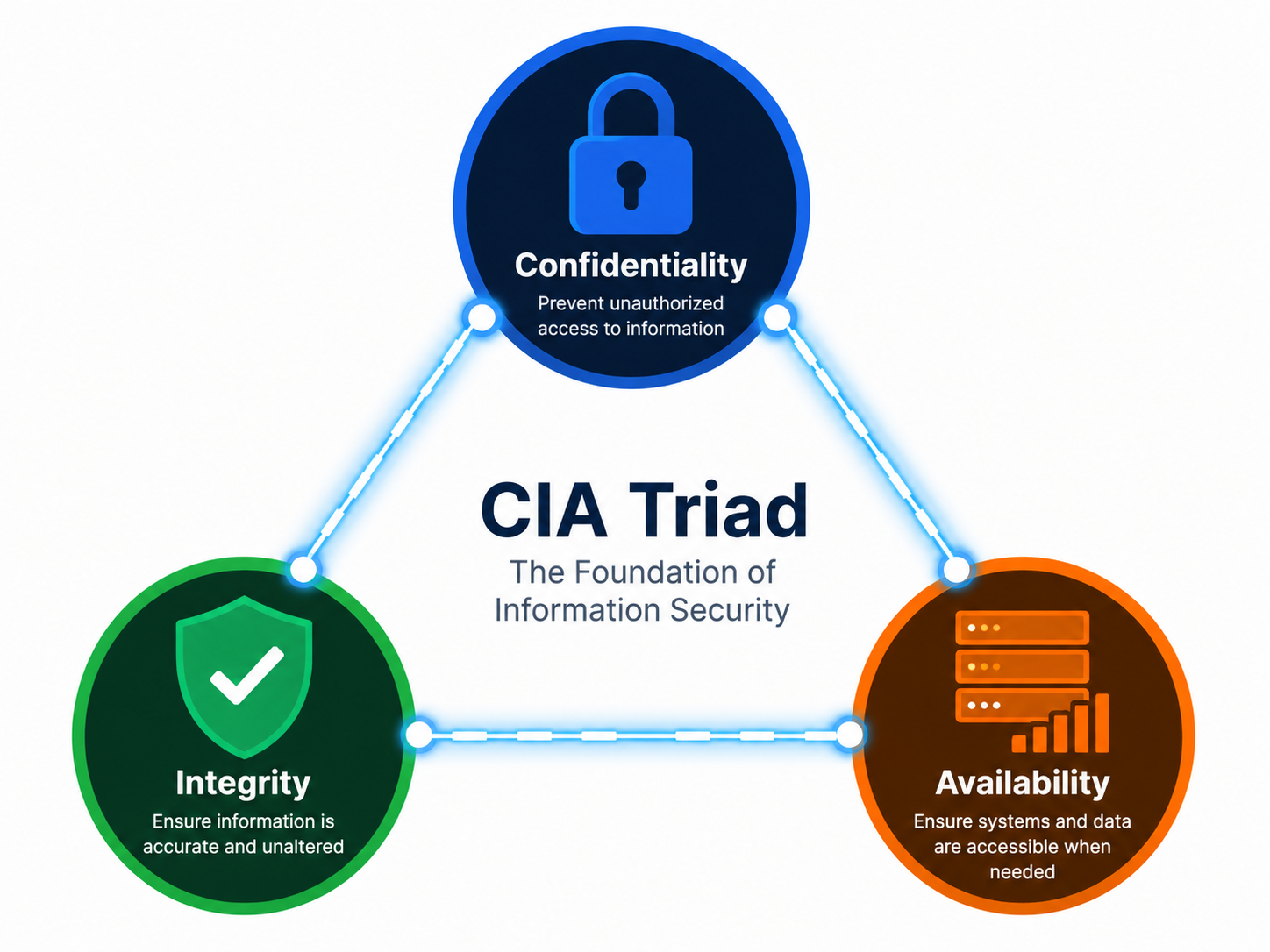
The CIA Triad is the foundational framework of information security. It defines three core objectives that every security control, policy, and technology is ultimately designed to protect: confidentiality, integrity, and availability. It is not named after any intelligence agency—the acronym is a deliberate construct that security professionals use as a mental checklist when evaluating risk, designing systems, or responding to incidents.
Think of it as the three-legged stool of cybersecurity. Remove any one leg, and the structure collapses. A system that is available and confidential but lacks integrity—say, a database where records can be silently altered—is just as dangerous as one that is taken completely offline. The CIA Triad forces practitioners to think about all three dimensions simultaneously rather than focusing on the loudest threat of the moment.
The framework is referenced across every major security standard and certification: NIST’s SP 800-53, ISO 27001, CompTIA Security+, CEH, CISSP, and the Cisco CyberOps Operations (200-201) exam, now named the CCNA Cybersecurity, all treat it as the baseline vocabulary for security reasoning. If you are preparing for any of these credentials, mastering the CIA Triad is not optional—it is the lens through which every other concept must be understood.
🎯 Exam Tip: If you are preparing for the CCNA cybersecurity exam, here is the handbook specially designed for exam preparation.
Why the CIA Triad Matters for Security Professionals
You might wonder why a three-word framework from the 1970s still commands this much attention in an industry defined by rapid technological change. The answer is that the CIA Triad is not a description of technology—it is a description of harm. The three pillars define the three ways that a threat actor can damage an organization: by exposing what should be private (confidentiality), by corrupting what should be trustworthy (integrity), or by denying access to what is needed (availability). Technology evolves; the nature of harm does not.
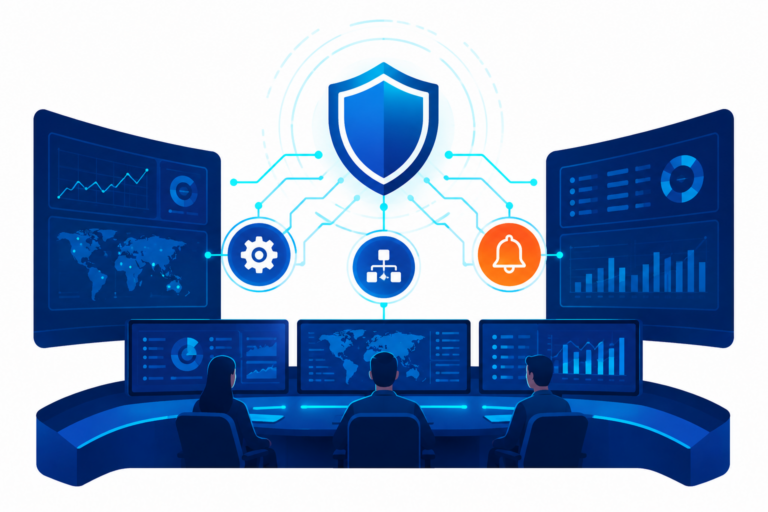
For a practicing SOC analyst, the CIA Triad is a real-time diagnostic tool. When an alert fires, the first question is always: Which pillar is being attacked? That single question determines escalation priority, the appropriate response playbook, and how quickly the incident needs executive attention. Learning to answer it instinctively — rather than after fifteen minutes of deliberation — is the difference between a contained incident and a catastrophic breach.
Breaking Down the 3 Pillars of the CIA Triad
Confidentiality: Controlling Who Sees What
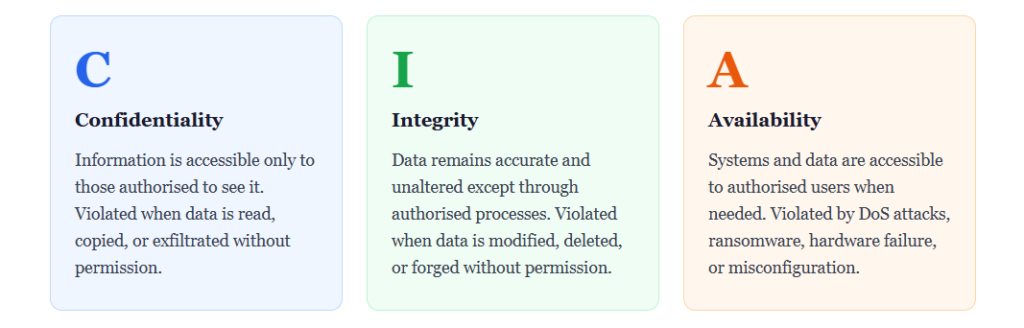
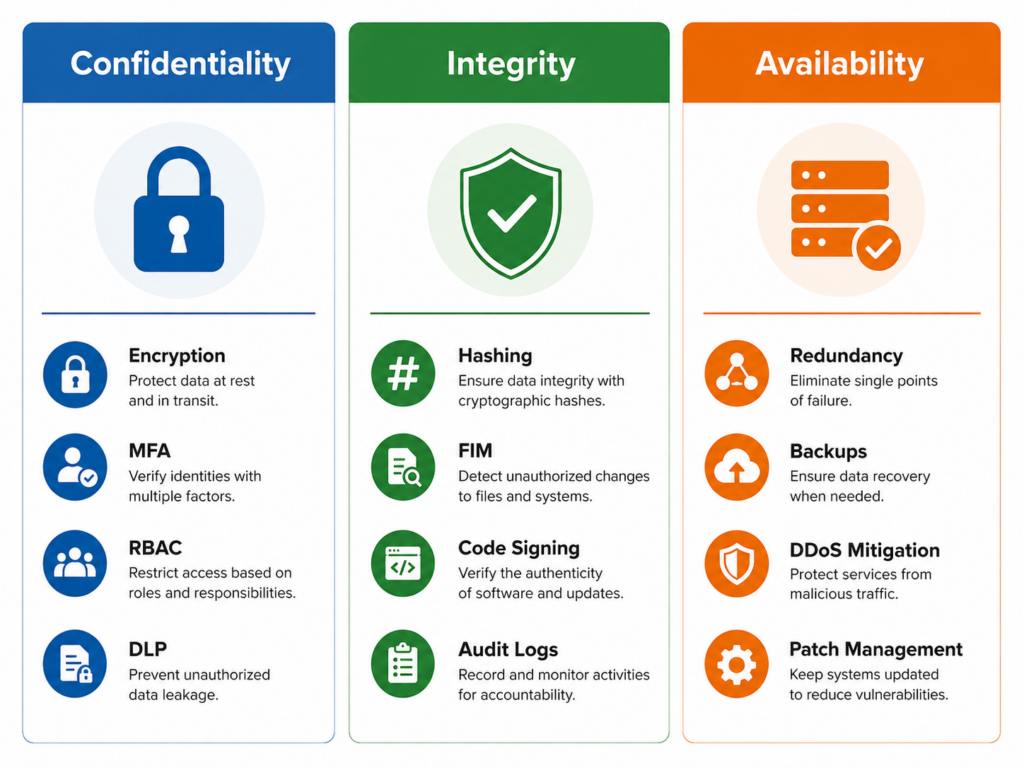
Confidentiality is the principle that information should only be accessible to those with explicit authorization to access it. It is enforced through a layered combination of access controls, encryption, data classification, and monitoring. Common implementations include role-based access control (RBAC), which grants access based on job function; attribute-based access control (ABAC), which adds contextual conditions like time of day or device type; and mandatory access control (MAC), common in government and defense environments, where access decisions are driven by security labels rather than user identity.
A confidentiality violation does not always require a dramatic breach. Leaving an unencrypted laptop on a train, misconfiguring an S3 bucket so it is publicly accessible, or failing to revoke an ex-employee’s credentials are all confidentiality failures. In each case, data that should be private becomes accessible to someone without authorization—and the damage can be just as severe as a nation-state-level intrusion.
Key controls for confidentiality include end-to-end encryption (TLS for data in transit and AES-256 for data at rest), data loss prevention (DLP) systems, network segmentation, and multi-factor authentication (MFA) as an access verification layer.
Integrity: Ensuring Data Can Be Trusted
Integrity addresses a subtler but equally dangerous problem: what if data is accessible, but wrong? An attacker who can silently alter medical records, manipulate financial transaction logs, or tamper with software update packages does not need to take a system offline to cause catastrophic harm. They simply need the victim to act on data they no longer understand to be corrupt.
Integrity controls fall into two categories: preventive and detective. Preventive controls include write access restrictions, code-signing for software (ensuring executables haven’t been tampered with), and database transaction controls that enforce ACID properties. Detective controls include cryptographic hash verification (comparing a file’s current hash against a known-good baseline), file integrity monitoring (FIM) tools like AIDE or Tripwire, and audit logs that track every change to sensitive records. Integrity is also why certificate authorities and PKI infrastructure exist: they provide a verifiable chain of trust that digital signatures have not been forged.
Availability: Keeping Systems Accessible When It Counts
Availability is the most operationally tangible pillar—and often the one that generates the most visible headlines. An organization whose patient records system, e-commerce platform, or power grid control panel goes offline faces immediate, measurable harm. Availability is threatened not only by deliberate attacks (Distributed Denial of Service, ransomware, and destructive wiper malware) but also by human error, hardware failure, software bugs, and natural disasters.
Availability engineering relies heavily on redundancy: failover clusters, geographic load balancing, regular offline backups tested for restoration, and high-availability (HA) configurations where no single point of failure exists. Incident response plans must account for availability scenarios specifically—the recovery time objective (RTO) and recovery point objective (RPO) are direct measurements of an organization’s availability commitment to its users.
5 Real-World CIA Triad Examples
Theory becomes instinct only through practice. Here are five distinct, documented scenarios that illustrate how the CIA triad works in the real world—and how each pillar can be violated independently or in combination.
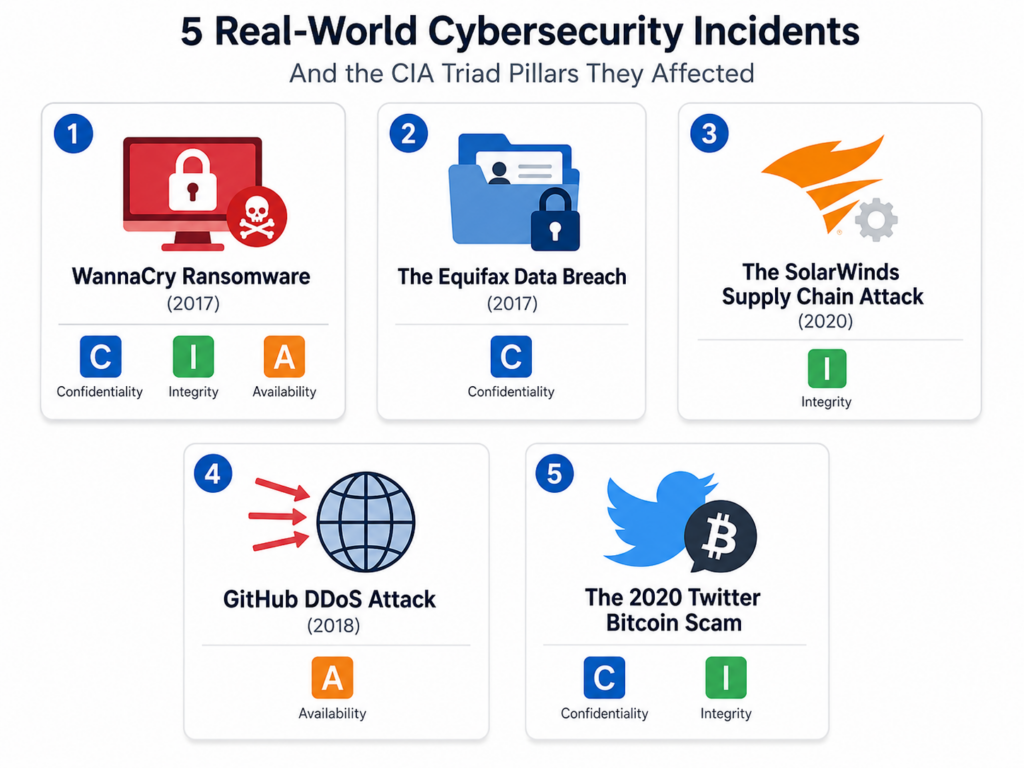
Example 1: WannaCry Ransomware (2017) — All Three Pillars
WannaCry is the canonical example of a CIA Triad multi-pillar attack. In May 2017, the ransomware exploited the EternalBlue vulnerability in Windows SMBv1 to self-propagate across networks without user interaction—infecting an estimated 200,000 systems across 150 countries in 72 hours. It attacked all three pillars simultaneously, which is precisely why it was so catastrophic.
| CIA Pillar | WannaCry’s Attack | Real-World Impact | Preventive Control |
|---|---|---|---|
| Confidentiality | Data exfiltrated before encryption and sold on dark web marketplaces | Offline backups, network segmentation, and applying the MS17-010 patch | Data Loss Prevention (DLP), network segmentation |
| Integrity | Files encrypted and renamed; originals deleted | Hospitals could not verify or trust any file on affected systems | File integrity monitoring, immutable backups |
| Availability | Entire systems locked with a ransom demand | UK’s NHS cancelled 19,000 appointments; surgeries postponed | Offline backups, network segmentation, applying MS17-010 patch |
The exam lesson here: when a scenario describes ransomware, the primary CIA pillar under attack is Availability—because the immediate business impact is denial of access, even if Confidentiality was also violated. Always identify the dominant impact.
Example 2: The Equifax Data Breach (2017) — Confidentiality
In September 2017, Equifax disclosed that attackers had accessed the personal data of approximately 147 million people—including Social Security numbers, birth dates, addresses, and credit card numbers. The breach exploited an unpatched Apache Struts vulnerability (CVE-2017-5638) and went undetected for 78 days. This is a textbook confidentiality violation: no data was destroyed, no systems were taken offline, and no records were altered. The sole harm was that private information became accessible to unauthorized parties.
The controls that failed were confidentiality-specific: patch management (the vulnerability had a fix available for two months before exploitation), network segmentation (lateral movement went undetected), and data minimization (the company retained far more data than was necessary for its core functions). The lesson is that confidentiality failures often result from neglect rather than sophisticated attack techniques.
Example 3: The SolarWinds Supply Chain Attack (2020) — Integrity
SolarWinds represents the most sophisticated integrity attack in recent history. Threat actors (later attributed to APT29, a Russian state-sponsored group) compromised the build pipeline of SolarWinds’ Orion software platform, inserting malicious code into a legitimate software update distributed to approximately 18,000 customers — including the U.S. Treasury, the Pentagon, and multiple Fortune 500 companies.
The victims did not have their data stolen or systems taken offline. Instead, they were made to trust software they believed to be authoritative but was not. Every action taken by any administrator using the compromised Orion update was potentially observable by the attacker. This is an integrity violation at the supply chain level: the mechanism of trust itself—a digitally signed software update—was subverted. The primary control that would have detected this is code-signing verification combined with build-pipeline integrity monitoring, a discipline now formalized under the SLSA (Supply Chain Levels for Software Artifacts) framework.
Example 4: GitHub DDoS Attack (2018) — Availability
On February 28, 2018, GitHub absorbed the largest distributed denial-of-service (DDoS) attack ever recorded at that time: a memcached amplification attack that peaked at 1.35 terabits per second. Attackers spoofed GitHub’s IP address in requests sent to publicly accessible memcached servers, which responded with amplified traffic—achieving an amplification factor of approximately 51,000x.
GitHub was offline for approximately 10 minutes before its DDoS mitigation partner (Akamai Prolexic) rerouted traffic and scrubbed the attack. No data was accessed, and no records were altered. This is a pure availability attack: the sole objective was to make GitHub’s service inaccessible to its millions of users. The control that contained the damage was not a firewall rule—it was a pre-arranged incident response relationship with a specialized mitigation provider, illustrating that availability defenses often need to exist outside the target network itself.
Example 5: The 2020 Twitter Bitcoin Scam — Confidentiality and Integrity
In July 2020, attackers used social engineering to manipulate Twitter employees into granting access to internal administrative tools. They then hijacked the verified accounts of Elon Musk, Barack Obama, Apple, Uber, and others to promote a Bitcoin scam that netted approximately $120,000 in two hours. This incident violated both confidentiality (internal administrative credentials and tools were accessed without authorization) and integrity (content published under trusted accounts was fraudulent). No systems were taken offline, making this a case where availability was entirely unaffected—yet the harm was significant.
The root cause was a failure of privileged access management (PAM): internal tools with enormous power were accessible through social engineering targeting low-level support staff, without sufficient controls on who could authorize access to verified account management functions.
CIA Triad Trade-Offs: Why Perfect Security Is Impossible
Here is the tension that every security architect lives with: the three pillars of the CIA Triad routinely conflict with each other. Maximizing one often means compromising another, and recognizing these trade-offs is essential both for certification exams and for real-world security design.
| Scenario | What You Gain | What You Sacrifice |
|---|---|---|
| Encrypting every file at rest | Confidentiality ↑ | Availability ↓ — slower access, key management overhead |
| MFA on every login | Confidentiality ↑ | Availability ↓ — users locked out during MFA failures |
| Read-only access to production databases | Integrity ↑ | Availability ↓ for write-dependent workflows |
| High-availability, replicated storage | Availability ↑ | Integrity risk ↑ — corrupted data replicates across all nodes |
This is not a flaw in the model—it is the model’s most important insight. Security design is fundamentally about trade-off management. The appropriate balance depends on the organization’s risk appetite, regulatory requirements, and the criticality of the assets being protected. A nuclear power plant will accept significant availability constraints to maximize integrity; a high-frequency trading platform may accept integrity risks (temporary inconsistency) to maintain microsecond availability. Neither decision is wrong—they reflect different threat models applied to the same framework.
CIA Triad on the Exam: What Certifications Actually Test
Certification exams do not test your ability to recite definitions. They test your ability to classify a scenario correctly under time pressure. Here is how the CIA Triad appears across the most common credentials:
🎯 Exam Tip
Cisco CyberOps 200-201: The exam frequently presents an attack scenario and asks which CIA pillar is most directly affected. Train yourself to identify the primary target first. A ransomware attack’s primary target is availability—even if confidentiality is also compromised, the dominant business impact is the lockout. A credential-stuffing attack targets confidentiality. A man-in-the-middle attack that alters packet contents in transit targets Integrity.
CompTIA Security+: This certification tests CIA Triad mapping in scenario-based questions across multiple domains. You may be described as an attack (e.g., “an employee accidentally published a customer database to a public GitHub repository”) and asked to identify which component of the CIA Triad was violated. The answer is confidentiality—but you need to recognize the pattern quickly, not puzzle through it.
CISSP: It goes deeper, expecting you to understand the managerial and legal implications of each pillar violation, not just the technical ones. A confidentiality breach may trigger GDPR notification requirements; an integrity failure in financial records may trigger Sarbanes-Oxley audit obligations; an availability failure for a critical infrastructure provider may trigger regulatory reporting under NERC CIP standards.
CEH: This exam frames CIA Triad questions through the attacker’s perspective: which pillar does a specific attack technique primarily target? SQL injection often targets confidentiality (exfiltrating database contents), and DNS cache poisoning targets integrity (corrupting name resolution); volumetric flood attacks target availability.
Best Practices for Applying the CIA Triad
Understanding the CIA Triad conceptually is the starting line. Applying it in a real environment requires systematic implementation across people, process, and technology.
Confidentiality Best Practices
Start with data classification—you cannot protect what you have not labeled. Implement a tiered classification scheme (public, internal, confidential, and restricted) and enforce access controls appropriate to each tier. Use encryption at rest (AES-256 is the current standard) and in transit (TLS 1.2/1.3 minimum; disable older protocols). Deploy a DLP solution to detect and block sensitive data leaving the organization through email, cloud uploads, or USB transfers. Enforce MFA on all privileged accounts and conduct regular access reviews to revoke credentials for departed employees and over-privileged accounts.
Integrity Best Practices
Deploy file integrity monitoring (FIM) on critical system files, configuration files, and application binaries. Store cryptographic hashes of known-good software versions and compare against them on a scheduled basis. Implement code-signing for all internally deployed software and reject unsigned executables. Use immutable backups—backup storage that cannot be modified or deleted even by a ransomware process that has obtained administrative credentials. Maintain detailed audit logs with tamper-evident storage (write-once, append-only log systems) so that any unauthorized change has a discoverable footprint.
Availability Best Practices
Design for redundancy at every layer: no single point of failure in network topology, power, storage, or application logic. Implement geographic distribution for critical services so that a regional outage does not take everything down. Maintain a tested, documented recovery plan with defined RTO (how quickly systems must be restored) and RPO (how much data loss is acceptable) targets. Conduct regular failover drills—a backup that has never been tested is not a backup. Engage a DDoS mitigation provider before you need one; negotiating a contract while under attack is not a viable strategy.
Common Misconceptions About the CIA Triad
Even experienced practitioners make these mistakes. Knowing them in advance saves considerable pain on both the exam and the job.
Mistake 1: Treating the three pillars as independent. Real attacks rarely target just one. WannaCry hit all three; the Twitter hack hit two. When analyzing an incident, assess all three pillars before concluding which was most affected. Stopping at the first match is how analysts miss secondary impacts that often turn out to be more damaging.
Mistake 2: Confusing Integrity with Availability. Ransomware that encrypts files is an availability attack (you can no longer use the files), not primarily an integrity attack (the data’s accuracy is not the issue—its accessibility is). Students frequently get this backwards because the encryption “changes” the files. The governing question is, what harm is the organization actually experiencing?
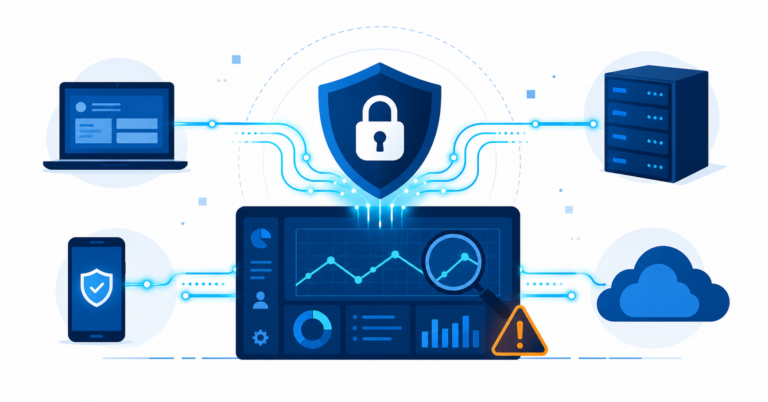
Mistake 3: Assuming the CIA Triad applies only to data. The framework applies to any digital asset: systems, network devices, application services, communication channels, and even the security tools themselves. A threat actor who compromises your SIEM is attacking the availability of your visibility—arguably the most dangerous availability attack possible in a SOC environment.
Mistake 4: Thinking that more security always means more safety. As the trade-off table above shows, excessive security controls can themselves create availability failures. An over-tuned DLP solution that blocks legitimate business emails is itself an availability problem. The goal is not maximum security on each pillar—it is an optimal balance given the organization’s threat model.
⚠️ Exam Watch
On scenario-based questions, always ask “which pillar is the primary impact?” before selecting an answer. Examiners deliberately design distractors that describe secondary impacts to catch students who stop at the first plausible match.
Practice Tests For Your Exam:
Conclusion
The CIA Triad—Confidentiality, Integrity, and Availability—is not an abstract framework that security students memorize and forget after their exam. It is the diagnostic lens that working analysts reach for every time an alert fires, every time a risk decision needs to be made, and every time a security architecture needs to be justified to stakeholders.
The three takeaways that will serve you longest: first, every security incident maps to at least one pillar—identifying which one is always your first question. Second, the pillars trade off against each other, and good security design means managing those trade-offs deliberately rather than maximizing any single one. Third, the real-world examples above—WannaCry, Equifax, SolarWinds, GitHub, and Twitter—are not just case studies for certification exams. They are the vocabulary of operational security, and knowing them cold means you can think on your feet when the scenario in front of you is new.