Here’s a number worth sitting with: Microsoft’s security ecosystem now spans Sentinel, Defender XDR, Entra ID, Purview, and Defender for Cloud—five separate product families that a single analyst is expected to monitor, correlate, and defend in real time. That’s the reality the SC-200 certification was built to test.
If you’ve ever stared at a flood of alerts and wondered whether you actually know how to triage them like a professional, this credential is the industry’s answer to that question. Officially titled “Microsoft Certified: Security Operations Analyst Associate“, the SC-200 certification validates that you can investigate, hunt, and respond to threats across Microsoft’s security stack—not just recognize the product names on a slide. Whether you’re a help-desk technician angling for a SOC role or a working analyst who wants a credential that matches your daily work, understanding exactly what this exam demands is the first step toward passing it.
Read Also: What Is Microsoft Sentinel? A Beginner’s Best Guide to Cloud SIEM
Table of Contents
What Is the SC-200 Certification?
The SC-200 certification is Microsoft’s associate-level credential for the security operations analyst role. Think of it as a driving test, but instead of proving you can parallel park, you’re proving you can sit in front of a Security Information and Event Management (SIEM) console and make sound decisions under pressure. According to Microsoft’s official certification page, a candidate for this exam “reduces organizational risk by performing triage, responding to incidents, hunting for threats, and engineering detections” using tools like Microsoft Sentinel, Microsoft Defender XDR, Microsoft Entra ID, Microsoft Purview, and Defender for Cloud workload protections.
Passing the exam earns you the title “Microsoft Certified: Security Operations Analyst Associate“, an intermediate-level credential under Microsoft’s Security, Compliance, and Identity track. It sits alongside—and is often paired with—the SC-300 (Identity and Access Administrator) and AZ-500 (Azure Security Engineer) certifications, but the SC-200 is the one squarely focused on the operational, day-to-day work of a Security Operations Center (SOC).
Read Also: CIA Triad Explained: A Complete Guide with 5 Real-World Examples
Why the SC-200 Certification Matters
Certifications are easy to dismiss as resume decoration, but the SC-200 certification behaves differently because it’s tied directly to a job function that’s in chronic short supply. Security operations teams are understaffed almost everywhere, and hiring managers increasingly use Microsoft’s associate-level security certifications as a fast filter for candidates who already understand SIEM and XDR workflows rather than needing months of onboarding.
There’s also a practical, day-to-day argument for it. The exam isn’t built around trivia; it’s built around the actual skills measured in a real SOC—configuring data connectors, tuning analytics rules, writing Kusto Query Language (KQL) hunting queries, and responding to multi-stage attacks. Studying for the SC-200 certification effectively forces you to build hands-on familiarity with the exact console workflows you’d use on the job. That’s a very different value proposition than memorising flashcards for an exam you’ll never apply again.
Read Also: A Comprehensive Guide to CyberArk PAM, Vault Components, Workflow, and Core Functionalities
How the SC-200 Exam Works
Before you build a study plan, you need a clear picture of the exam mechanics — timing, scoring, and how Microsoft structures the questions. The SC-200 certification exam isn’t a simple multiple-choice quiz; it includes interactive components and case-study-style scenarios that mirror the decisions a real analyst has to make.
Exam Format, Duration, and Scoring
You’ll have 100 minutes to complete the assessment, and it’s proctored, either in person at a testing centre or remotely online. A passing score is 700 or greater, measured on Microsoft’s standard 100–1000 scale used across its role-based exams. If you don’t pass on your first attempt, Microsoft’s retake policy allows you to try again 24 hours later, with the waiting period increasing for subsequent retakes. The exam is available in ten languages, including English, Japanese, Korean, French, German, and Spanish, so international candidates aren’t limited to English-only testing.
Skills Measured at a Glance
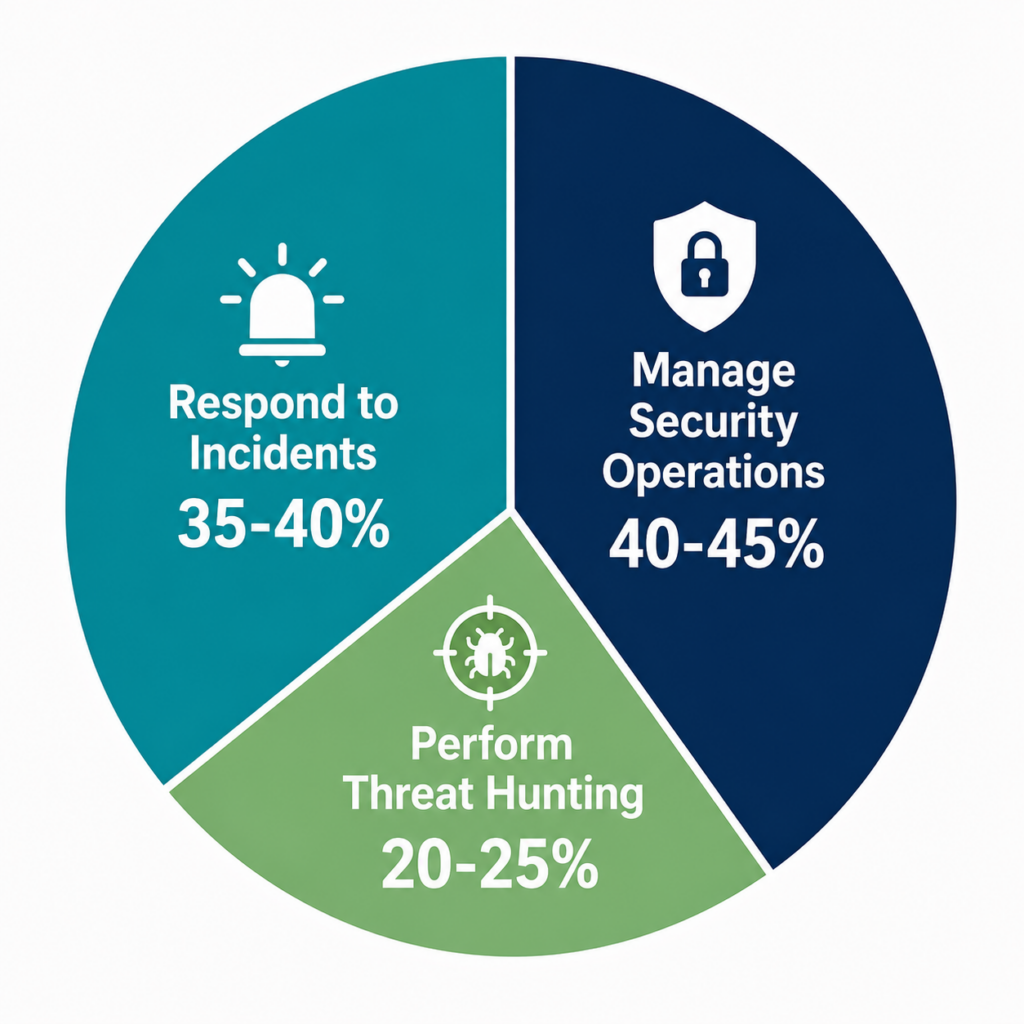
As of the most recent update to the SC-200 certification, the exam is broken into three weighted skill domains: manage a security operations environment (40–45%), respond to security incidents (35–40%), and perform threat hunting (20–25%). That weighting tells you something important — nearly half the exam is about configuration and platform management, not just incident response. A lot of candidates study incident response scenarios almost exclusively and get caught off guard by how much of the exam tests Sentinel and Defender XDR configuration skills instead.
Key Skills Domains Tested in the SC-200 Certification
Each of the three domains covers a distinct slice of the security operations analyst’s job. Understanding what falls under each one helps you allocate your study time proportionally instead of spreading yourself thin across topics that carry unequal exam weight.
Read Also: Automation Rules and Playbooks in Microsoft Sentinel: A Comprehensive Guide
Manage a Security Operations Environment
This is the largest domain, and it centers on configuring the tools rather than just using them. You’re expected to know how to configure automation rules and playbooks in Microsoft Sentinel, set up data connectors and Windows Security Event collection via the Azure Monitor Agent (AMA), build custom detection rules using Advanced Hunting in Defender XDR, and manage Sentinel workbooks and SOC optimization recommendations. It also covers Microsoft Defender for Endpoint configuration, including attack surface reduction (ASR) rules and automated investigation settings.
Respond to Security Incidents
This domain tests your ability to investigate and remediate live threats across the Microsoft security stack—Defender for Office 365, Purview, Defender for Cloud Apps, Entra ID, Defender for Identity, and Sentinel itself. It also includes newer, exam-relevant skills such as investigating incidents with agentic AI tools like Microsoft Security Copilot, handling multi-stage and lateral-movement attacks, and managing incidents through structured case-management workflows.
Perform Threat Hunting
The smallest domain by weight but arguably the most technically demanding, threat hunting tests your fluency with Kusto Query Language (KQL). You’ll need to identify the correct table for a given hunting scenario, build advanced hunting queries, interpret threat analytics, and construct hunting graphs—including analyzing “blast radius” to understand how far a compromise has spread. Candidates who skip hands-on KQL practice tend to struggle most in this section, since there’s no way to fake query-writing fluency in a scenario-based question.
Best Practices to Prepare for the SC-200 Certification
Passing the SC-200 certification isn’t about cramming terminology—it’s about building muscle memory in the actual consoles. Here’s a practical approach that lines up with how the exam is weighted.
- Get a free Microsoft trial tenant. Spin up a Microsoft 365 E5 or Sentinel trial workspace and actually configure data connectors, analytics rules, and playbooks yourself—reading about it isn’t the same as clicking through them.
- Prioritise KQL practice daily. Spend at least 20–30 minutes a day writing Kusto Query Language queries against sample data, since threat hunting questions are almost entirely scenario-based.
- Study the domains in proportion to their weight. Since managing the security operations environment accounts for 40–45% of the exam, don’t let incident-response scenarios crowd out configuration topics like AMA data collection rules or Sentinel automation.
- Use Microsoft’s official practice assessment. It mirrors the real question style and difficulty far more closely than third-party dumps, and it’s free.
- Watch the official exam-readiness videos. Microsoft publishes preparation videos that walk through common question patterns and console workflows relevant to the SC-200 certification.
- Review the MITRE ATT&CK framework. Several exam questions ask you to map detections or attack vectors to ATT&CK tactics, so basic familiarity with the framework pays off.
Common Mistakes and Misconceptions
The most common misconception is that the SC-200 certification is a mid-level exam because it’s labelled “associate”. In practice, it assumes you’re already comfortable with Microsoft 365, Azure cloud services, and basic identity concepts—Microsoft explicitly lists these as prerequisite familiarity areas, not exam topics it teaches from scratch. Walking in without that foundation is the single biggest reason candidates fail.
Another frequent mistake is treating the exam as pure memorization. Because the SC-200 certification leans heavily on scenario-based and interactive question types, candidates who’ve only read documentation—without ever configuring a Sentinel workbook or running a live KQL query—often struggle to apply concepts under exam conditions. Finally, many candidates underestimate the threat-hunting domain simply because it carries the smallest percentage weight, then get blindsided by how much KQL fluency it actually demands relative to its 20–25% share of the exam.
Real-World Example: From Alert to Action in a SOC
Imagine a mid-sized retail company’s SOC receives a Microsoft Sentinel alert flagging unusual sign-in activity from an Entra ID account, followed minutes later by a Defender for Endpoint alert on the same user’s laptop. An analyst trained for the SC-200 certification wouldn’t treat these as two separate tickets. They’d recognise the correlation, pivot into Defender XDR’s unified incident view, check the device timeline, and use KQL to query for related process activity across the environment — exactly the kind of multi-domain, multi-stage investigation the “Respond to security incidents” domain is built to test. That’s the practical payoff of the certification: it’s not an abstract credential; it’s a rehearsal for the actual first ten minutes of a real breach investigation.
Read Also: ISC2 CC Certification: Exam Structure, Key Domains with Useful Practice Tips
Conclusion
The SC-200 certification rewards candidates who treat it as hands-on training rather than a memorization exercise. Three things matter most: study the domains in proportion to their exam weight, since managing the security operations environment carries the heaviest share; build real fluency with KQL, because threat hunting questions can’t be talked around; and get actual console time in Sentinel and Defender XDR before exam day.
For anyone serious about a security operations career, this credential isn’t just a line on a resume—it’s a structured way to validate the exact skills a modern SOC needs. Ready to start? Take Microsoft’s free practice assessment this week, and drop a comment below with which exam domain feels the toughest—we’ll cover it in the next guide.